
How to Set Up a 24/7 Twitch Stream From Pre-Recorded Video
Written by AndrewFounder of Streamloop
A 24/7 Twitch stream is simpler than it looks. Technically, Twitch receives a finished playlist the same way it receives a camera or gameplay feed: as a normal RTMP broadcast. Your channel appears in the live directory, the player behaves normally, and chat stays open.
This guide is for streamers who already have videos — past broadcasts, a YouTube back catalogue, edits nobody has seen — and want a nonstop channel running from them without babysitting it.
The 60-second version: copy your Twitch stream key, point a cloud loop at Twitch's current RTMPS ingest, start at 1080p and 30 fps, and let it run. The rules matter more than the setup — loop only what you own, treat the music as the main risk, and do not expect an always-on channel to carry you to Affiliate.
There are three practical ways to produce that continuous feed:
| Column 1★ | Best for | Main drawback |
|---|---|---|
| ● Streamloop | A hands-off video or playlist loop | You pay while the stream is running |
| ● OBS with VLC Video Source | A free experiment from a spare computer | The machine must stay awake and connected |
| ● FFmpeg on your own server | Developers who want to manage everything themselves | You maintain the server, restarts and playlist logic |
- Column 1
Streamloop
- Best for
A hands-off video or playlist loop
- Main drawback
You pay while the stream is running
- Column 1
OBS with VLC Video Source
- Best for
A free experiment from a spare computer
- Main drawback
The machine must stay awake and connected
- Column 1
FFmpeg on your own server
- Best for
Developers who want to manage everything themselves
- Main drawback
You maintain the server, restarts and playlist logic
I built Streamloop for the first option, so that is the setup I walk through below. I am obviously not neutral, but I also do not think one tool fits everyone. For a broader comparison, see my guide to the best 24/7 streaming software. If you prefer maintaining your own server, the FFmpeg loop guide covers that route in detail.
This guide is Twitch-specific. For the general case across platforms, see running a 24/7 live stream from pre-recorded video; for why you would want an always-on channel at all, the real advantages of live streaming pre-recorded video.
Can you run pre-recorded video 24/7 on Twitch?
Yes. A 24/7 live stream built from pre-recorded video is an ordinary broadcast as far as Twitch is concerned. Twitch even has an Always On category for it, although you should still choose the category that most accurately describes what is playing.
The format itself is not the problem. The normal Twitch rules still apply: use video, music and artwork that you created or have permission to rebroadcast; describe the stream honestly; and moderate the chat even when nobody is sitting at the keyboard.
A few formats fit particularly well:
- gaming highlights and past broadcasts
- podcast, interview or talk-show archives
- art, coding or building timelapses
- ambient scenes, music radio and visualizers
- marathons of an original series
The common thread is that a viewer can arrive at almost any moment and understand what is happening. A playlist of evergreen videos works much better than a recording full of old announcements such as “I'll be back tomorrow at 6.” Time has no mercy for stale lower thirds.
This is not Twitch's “Rerun” feature
Worth clearing up early, because the two get confused constantly.
Twitch has a built-in Rerun tool that rebroadcasts your existing VODs. It looks like the same thing and is not. Reruns are gated behind Affiliate status, Twitch badges them separately in the directory so viewers can tell them from live channels, and — per Twitch's own announcement — you cannot go live while a rerun or premiere is running.
An RTMP loop is a normal broadcast. Twitch sees a live stream, because that is what it is receiving. The one-stream-per-channel rule still applies, but nothing is capped, badged or gated.
Should you use the Always On category?
The Always On category is a real Twitch directory category, and it is where nonstop channels congregate. It is worth understanding before you park yourself there.
The top of it is a mix. Dedicated round-the-clock operations sit alongside established creators using it as a home for archive content. Below the first handful of channels, average viewership falls under 100 fast.
That thin tail is the argument for and against. Against: there is not a large ambient audience browsing the category. For: the competition is shallow, and the label tells a viewer exactly what they are clicking on, which sets expectations correctly for a channel with nobody at the keyboard.
My rule of thumb: use Always On when the channel is a general archive or a station-style continuous stream with no single subject. When the loop is about something — one game, art, a podcast — put it in that category instead and let the tags carry the always-on signal. Category accuracy matters more than category strategy.
What you need before starting
You only need three things: a Twitch channel with live-streaming access, your Twitch stream key, and the videos you want to play. Those videos can be uploaded files or an existing YouTube playlist.
You do not have to download and re-upload anything by hand. Streamloop takes uploads from your computer and also imports media you already have online — Google Drive, Dropbox, a direct link, or a whole YouTube playlist by URL.
How to set up the 24/7 Twitch stream
Copy your Twitch stream key
Open Twitch and go to Creator Dashboard → Settings → Stream → Stream Key & Preferences. Reveal your primary stream key and copy it. This is the path in Twitch's stream-key guide too. Twitch uses this key to decide which channel receives the incoming feed.
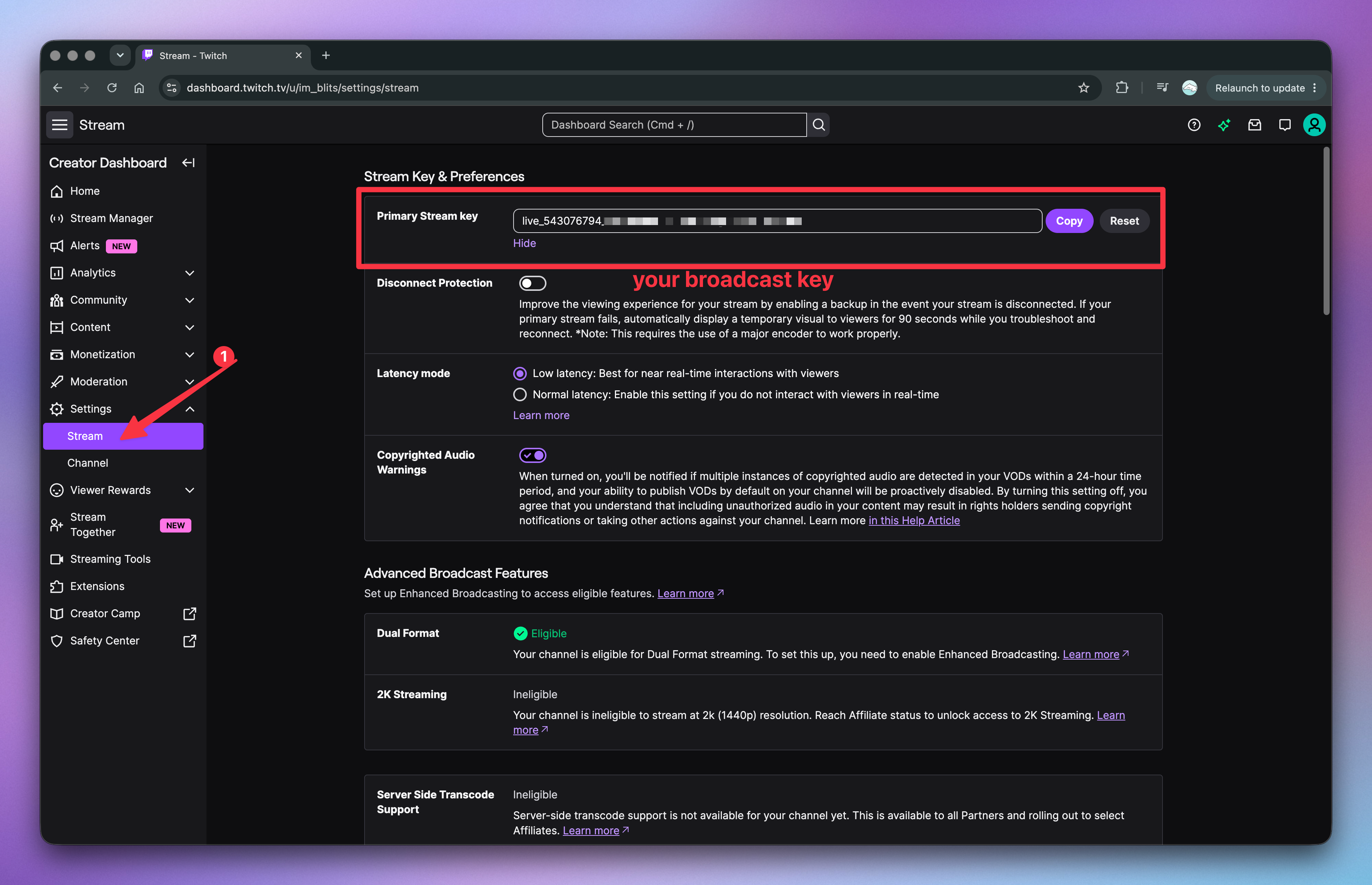
Treat the key like a password. Do not paste it into a screenshot, send it in a support message, or leave it visible during a screen recording. If it is ever exposed, reset it on the same settings page — a reset invalidates the old key everywhere, immediately, so anything still using it goes dark until you update it.
While you are in Twitch, open Stream Manager → Edit Stream Info and set a clear title, the most accurate category, relevant tags, and the correct content classification labels where required.
Create a loop in Streamloop
Create an account at streamloop.app, open the dashboard and click Create new loop. Give it a name that is useful inside your account, such as Twitch highlights or Podcast archive. This internal name does not become the public Twitch title.
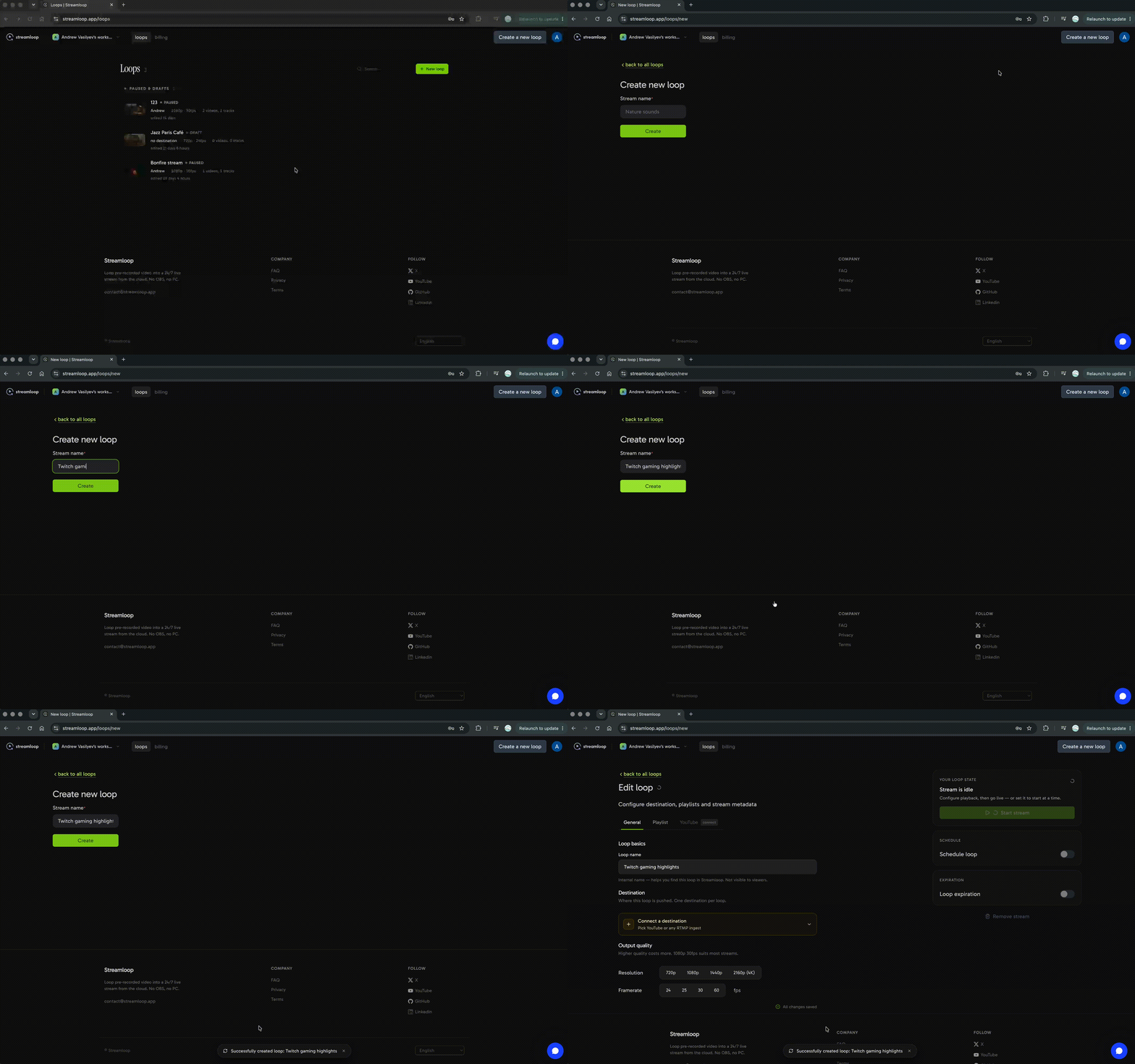
You will land in the loop editor. The two sections you need are Playlist, where you add and arrange the videos, and General, where you choose quality and connect Twitch. New accounts include free trial credits and no card is required, so you can run a real stream before paying anything.
Add your videos
Open Playlist → Video. Click Upload to add MP4, MOV or MKV files from your computer, or import media you already have online — Google Drive, Dropbox, YouTube or a direct link — instead of downloading and re-uploading it. Uploading originals is the better route when you still have the masters, the videos were never published anywhere, or you want a Twitch-specific edit.
If your archive happens to live in a YouTube playlist, you can bring the whole thing in at once: click From URL and paste the playlist URL. After the import finishes, reorder or remove videos inside Streamloop before going live. Worth knowing if you were about to fetch them by hand instead — YouTube Studio's own export caps you at 720p or 360p depending on file size and allows five downloads per video per day, and third-party downloaders breach YouTube's terms even for your own uploads.
Under Loop behavior, choose In order to play top to bottom and repeat, Shuffle to randomise without repeating an item until everything has played, or Custom order for rules such as playing an intro once and then looping the rest. Streamloop also supports a separate audio playlist — read the music section below before you use it. Whatever fills the playlist, mix the lengths: a wall of forty-minute uploads gives someone landing on your channel a much worse first thirty seconds than a highlight reel does.
Connect Streamloop to Twitch
Open the General tab and click Connect a destination. Choose RTMP stream key, name it Twitch, and set the RTMP URL to rtmps://ingest.global-contribute.live-video.net/app. Paste the primary stream key you copied from Twitch and save.
Use the secure address above rather than an old guide that still points at live.twitch.tv. Twitch moved ingest to live-video.net back in January 2021 and publishes the current server list, including regional endpoints, as open JSON at ingest.twitch.tv/ingests. Most guides ranking for this topic still have the old hostname.
Choose the stream quality
For most pre-recorded Twitch loops, start with 1080p at 30 fps. It is a sensible default for podcasts, ambient video, replays, art and most highlight rotations. Use 60 fps when motion genuinely benefits from it, such as fast gameplay. Sending twice as many frames for a nearly static podcast shot mostly buys you a larger bill and no applause.
Twitch raised its ceilings at TwitchCon Rotterdam in June 2026: 1440p is now open to Partners and Affiliates, at up to 9 Mbps, with 7.5 Mbps at 1080p. If you read somewhere that 6,000 kbps is the hard cap, that guide is out of date.
Start the 24/7 Twitch stream
Before going public, test quietly. Twitch's developer documentation notes that appending ?bandwidthtest=true to your stream key makes Twitch accept the feed without showing it to viewers. Point your loop at that first, confirm the connection holds, then remove the flag.
Click Start stream, or schedule a start time. Open your Twitch channel on another device and confirm three things: the correct video is playing, the audio level is sensible, and the title and category match the content. After that you can close your laptop — the feed runs from Streamloop's servers, not your browser.
How to change the playlist while the Twitch stream is live
You do not have to stop the broadcast just to add another episode or remove a weak video. If you use Streamloop, you can open the live loop, go to Playlist, and add, remove or reorder the videos. Streamloop keeps those edits as a draft until you click Publish. The new playlist takes over after the current video ends, without restarting the Twitch broadcast.
Quality, frame rate and destination changes are different: those require a restart. Playlist changes do not. This is one of the main reasons I prefer a proper playlist tool over a single media source in OBS. A 24/7 channel is rarely finished forever on day one, and taking the whole stream down for every small change gets old very quickly.
What happens when you want to stream live normally?
Stop the Streamloop broadcast before starting OBS, a console stream, or another encoder on the same Twitch channel. Twitch accepts one active broadcast for a channel at a time. When the normal live session ends, start the loop again. Keep the 24/7 setup saved rather than rebuilding it each time; then switching between the archive loop and a regular live show is just stop, stream, restart.
Twitch rules that matter for an unattended stream
The technical setup is only half of the job. An unattended channel is still your channel.
Music is the biggest single risk
Everything else on this list is a one-time check. Music is the thing that keeps costing you.
A loop replays the same audio bed dozens of times a day, forever. One unlicensed track is not one DMCA claim — it is a claim generator. Twitch has been open about the scale here: in its 2020 post on music copyright, it said streamers collectively received fewer than 50 music-related DMCA notifications a year before May 2020, after which labels began sending thousands per week, with over 99% targeting background music. That is exactly what a loop is.
The enforcement path matters too. A DMCA notice gets the content removed and the channel notified; enough copyright strikes and the account goes. Your VODs and clips are where the claims land, so a continuous stream quietly builds a bigger surface every day it runs.
Your own archive is not automatically safe
Use only material you created or have permission to rebroadcast. Check old videos for music, clips, guest footage and other elements whose licenses may have been limited to the original upload.
Also check them against today's rules, not the rules when you published. In March 2025 PewDiePie started an “infinity stream” looping his own old YouTube uploads. The channel was banned in early May and restored a couple of days later, with no public explanation from Twitch. His own theory: “Probably shouldn't have been streaming the videos from 2017.”
Moderation, honesty and Drops
Set up AutoMod and appoint moderators who are around during at least part of the day. Twitch expects streamers to address abusive behavior in their chats even when the video itself is harmless.
Do not use old gameplay or static footage to farm Twitch Drops — Twitch explicitly treats that as abuse of the rewards system. And keep the title, category and tags honest; a pre-recorded Elden Ring marathon should not sit in whichever category happens to be trending that afternoon.
Will a 24/7 stream get you to Affiliate?
Short answer: not on its own, and it can work against you.
Twitch lowered the Affiliate bar in June 2026 to 4 hours streamed, 4 distinct broadcast days, 3 average concurrent viewers and 25 followers. The follower and hour requirements are easy. The average concurrent viewer number is the one that matters, and it is the one a 24/7 channel damages: every quiet hour at 4am is counted, and there are a lot of them.
Twitch Support has also stated that rerun hours do not count toward the ongoing-eligibility baselines it measures. The useful framing is that an always-on loop is a discovery surface and a home for your archive, not a shortcut to monetization. Do your qualifying hours live and let the loop work the directory while you sleep.
Worth knowing separately: since April 2025 Twitch caps highlights and uploads at 100 hours of storage per channel. Past broadcasts and clips are not affected, but if you plan to archive a 24/7 channel, you will meet that ceiling.
The other two ways to run a 24/7 Twitch stream
OBS and VLC Video Source
OBS is free and works for a basic loop. Install VLC, add a VLC Video Source, add the files and enable playlist looping. It has to be the VLC source, not the standard Media Source — per OBS's documentation, Media Source plays a single file with a Loop checkbox, while VLC Video Source is the one that builds playlists.
The trade-off is straightforward: the computer must stay awake, connected and healthy every hour the channel is live. A reboot, update, internet outage or accidental closing of OBS ends the stream. OBS's own forum is blunt about the use case — “OBS Studio isn't designed for unattended 24/7 streaming of dead media such as prerecorded mp4 files,” in a thread that also reports Media Source cutting out after about three days. I would use this for a temporary test, not an unattended channel I expect to run for weeks.
FFmpeg on your own server
FFmpeg gives you the most control and can be inexpensive when you already manage servers. It can loop a file indefinitely — -stream_loop -1 — and send it straight to Twitch over RTMP. The work is in everything around the command: preparing compatible files, building playlists, handling clean transitions, reconnecting after failures and updating content without ugly gaps. My FFmpeg 24/7 loop guide covers the commands and encoding choices.
Frequently asked questions
How do 24/7 streams work?
An encoder sends pre-recorded video to Twitch's RTMP ingest servers continuously, and Twitch treats it as an ordinary live broadcast. The encoder can be a cloud service, OBS on a machine you leave running, or FFmpeg on a server. The only difference from a normal stream is that nobody is sitting at the keyboard — and that the setup has to restart itself when Twitch ends the session at 48 hours.
Can I stream pre-recorded videos on Twitch?
Yes. Twitch accepts a normal RTMP feed whether the source is a camera, gameplay capture, or a pre-recorded playlist. Use content you created or have permission to rebroadcast, and follow the same platform rules that apply to any live channel.
Does a 24/7 loop count as a rerun?
No. Twitch's Rerun feature is a separate tool — Affiliate-gated, badged differently in the directory, and it blocks you from going live while it runs. An RTMP loop registers as an ordinary live broadcast.
Where do I find my Twitch stream key?
Creator Dashboard → Settings → Stream → Stream Key & Preferences → Show. It goes by several names — Twitch streaming key, Twitch TV stream key, or just your Twitch key — but there is only one primary key per channel, and it is the same value every encoder asks for.
Where can Streamloop import videos from?
Upload MP4, MOV or MKV files from your computer, or import from Google Drive, Dropbox, a direct link, or a YouTube playlist. In Playlist → Video choose Upload or From URL. A YouTube playlist comes in whole, so you can arrange it inside Streamloop afterwards.
Do I have to download my videos before uploading them?
No. Streamloop pulls from Google Drive, Dropbox, a direct link or a YouTube playlist URL, so files you already have online never touch your disk twice. You only need local files for the OBS or FFmpeg routes — and if those files are coming out of YouTube Studio, note its export caps you at 720p.
Do I need to leave my computer on?
Only with OBS. A cloud service or a self-managed server runs the stream without your machine involved.
Can I edit the playlist without ending the Twitch stream?
Yes. Add, remove, or reorder videos, then publish the draft. The revised playlist takes over after the current item finishes while the broadcast remains live.
How long can one Twitch broadcast run?
Twitch sets a maximum broadcast length of 48 hours in its broadcasting guidelines. An always-on setup must reconnect and begin a new broadcast session when that limit is reached.
Can I put music on repeat 24/7?
Only if you hold the rights or the tracks come from a library licensed for streaming — Pretzel Rocks, NCS, Chillhop, Outertone. Soundtrack by Twitch shut down in 2023, and the DJ Program only covers live DJ sets. A loop replays the same track hundreds of times a week, so an unlicensed one is a repeating claim rather than a one-off risk.
Will a 24/7 stream get me to Affiliate?
Not by itself. Rerun hours are excluded from Twitch's baselines, and a channel that is live around the clock drags down its own average concurrent viewer count — the exact metric the Affiliate requirement measures. Use the loop for discovery and hit your qualifying hours with live broadcasts.
Can you stream 24/7 on YouTube too?
Yes, and it is slightly easier there — YouTube has no maximum broadcast length, so a nonstop loop needs no scheduled restarts at all. Most cloud tools, Streamloop included, can push the same playlist to both platforms at once. The rights questions apply equally to both.
How does Lofi Girl stream 24/7?
The same way as everything in this guide, with better licensing. It is a looping animation over a music playlist, pushed continuously from a server rather than someone's desktop. The technical setup is unremarkable; the hard and expensive part is holding rights to the music, which is why the format is easy to copy and hard to copy well.
How much do 24/7 live streams make?
There is no useful average, and anyone quoting one is guessing. What matters is the mechanism: revenue on Twitch comes from subs, Bits and ads, all of which scale with concurrent viewers — and a nonstop channel spends most of its hours with very few. A loop earns from the hours people actually watch, not from being live. Treat it as a way to catch traffic you would otherwise miss overnight, not as passive income.
Can I use the same Twitch channel for regular live streams?
Yes. Stop the 24/7 loop first, start your normal live broadcast, and restart the loop afterward. Twitch accepts one active broadcast per channel, so two encoders cannot run at the same time.
Where to go next
Pick videos you actually own, check the music, grab your stream key and point a loop at Twitch. The technical part takes minutes; the content and rights decisions are what determine whether the channel is still up next month.
Start your 24/7 Twitch stream
Build a playlist from your own videos, add your Twitch stream key, and let it loop from the cloud while your computer stays off. New accounts get free trial credits, no card required.