
How to Run a 24/7 Live Stream From Pre-Recorded Video
Written by AndrewFounder of Streamloop
To set up a 24/7 live stream from pre-recorded video you need three things: a video or playlist, a destination such as YouTube or Twitch, and something that keeps feeding that video to the destination without stopping. Which method you pick decides how much of that last part you maintain yourself.
There are three practical ways to do it: run OBS on a computer that never sleeps, run FFmpeg on an always-on server, or use a service built for continuous playback. This guide covers the trade-offs first, then walks through the full setup with Streamloop.
I built Streamloop for this job, so it is the method I know best and the one documented step by step below. The other two are real options and I have said where each one wins.
This guide assumes you have already decided an always-on channel suits your content. For the reasoning, use cases and trade-offs, read the benefits of live streaming pre-recorded video.
The 60-second version: pick a method — a cloud service for unattended streams, OBS for quick tests, FFmpeg for full control. Upload a video or build a playlist and choose how it repeats. Set the quality; 1080p at 30 fps suits most channels. Connect YouTube directly, or paste an RTMP URL and stream key for anything else. Then start the stream or schedule it, and close your laptop.
Three ways to run a 24/7 live stream
| Column 1★ | Best for | Main drawback |
|---|---|---|
| ● Cloud streaming service | The simplest unattended setup | You pay while the stream is running |
| ● OBS on your computer | Short tests and temporary streams | The machine must stay on and connected |
| ● FFmpeg on a server | Technical users who want full control | You maintain the server, restarts and playlist logic |
- Column 1
Cloud streaming service
- Best for
The simplest unattended setup
- Main drawback
You pay while the stream is running
- Column 1
OBS on your computer
- Best for
Short tests and temporary streams
- Main drawback
The machine must stay on and connected
- Column 1
FFmpeg on a server
- Best for
Technical users who want full control
- Main drawback
You maintain the server, restarts and playlist logic
Option 1: a cloud streaming service
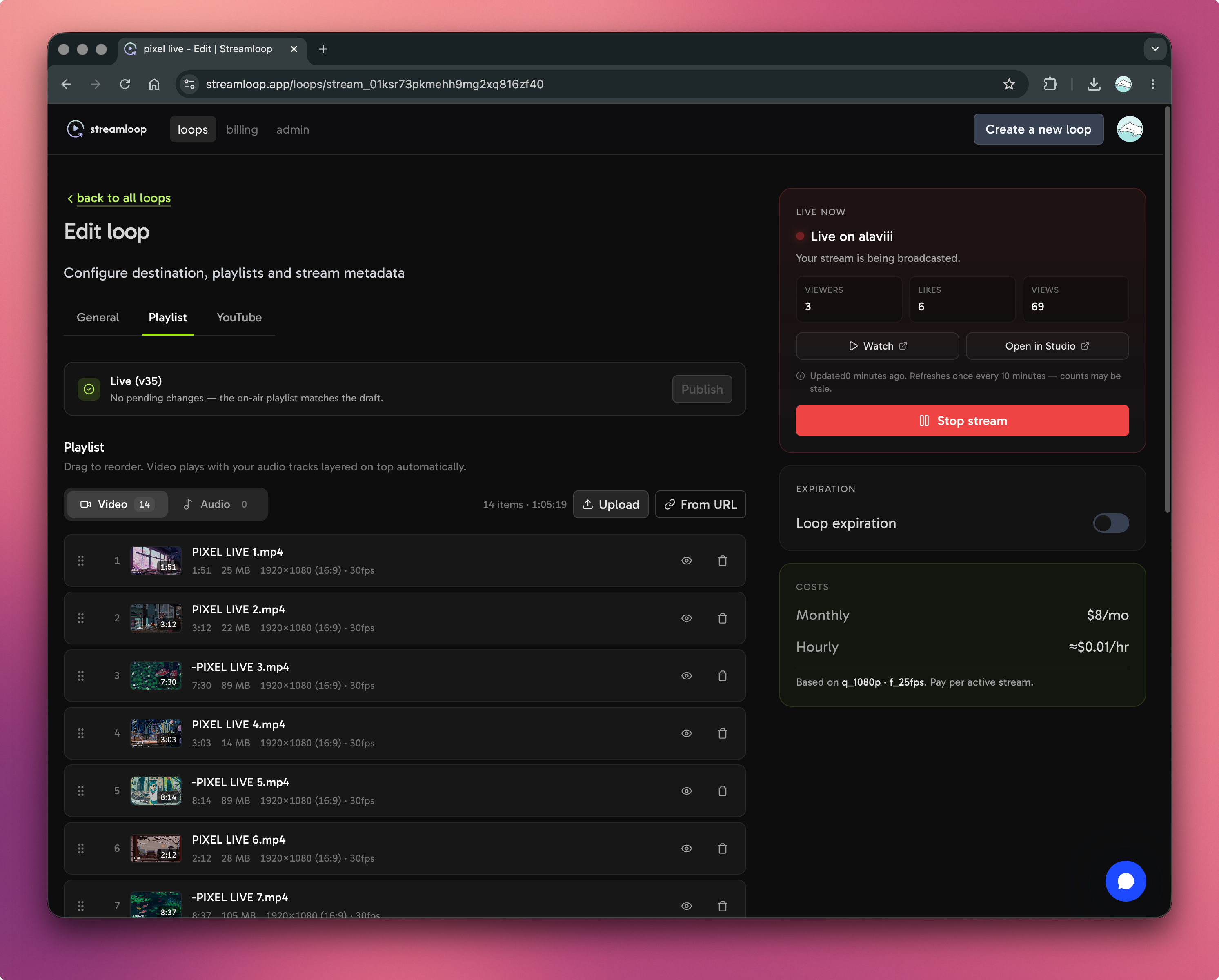
You upload one video or a playlist, choose a quality, connect the destination and start. The stream keeps running after you close the browser or shut the computer down, because none of it depends on your machine. That is the method covered step by step below.
Streamloop is not the only hosted option. Some alternatives lean more toward overlays, multistreaming or interactive production. I compared the main ones in best 24/7 streaming software for pre-recorded video.
Option 2: OBS on your own computer
OBS can loop a local file through a Media Source and send it to YouTube, Twitch, Facebook Live or anywhere else. It is free, and for a short stream it works well.
The catch is that the whole broadcast depends on your computer. Sleep mode, a system update, a dropped connection, or simply closing the lid ends it. For a quick experiment OBS is fine. For a channel meant to run for weeks, it is the awkward option.
Option 3: FFmpeg on an always-on server
FFmpeg can loop a file indefinitely and push it straight to an RTMP destination. Its -stream_loop -1 option repeats an input forever, as described in the FFmpeg documentation. It gives you complete control and can be inexpensive to run.
It is also the most technical route. You prepare the file, run the server, restart failed processes, reconnect after interruptions and build any playlist behaviour yourself. The actual commands and codec choices are in how to loop a video for a 24/7 YouTube live stream with FFmpeg.
How to run a 24/7 live stream with Streamloop
Six steps, start to finish.
Create an account and a new loop
Sign up at streamloop.app with Google or an email address, then click Create new loop and give it an internal name such as Lofi radio or Nature stream. The loop holds the whole setup: media, playback order, quality, destination and schedule. That internal name does not have to match the title viewers see.
New accounts include free trial credits and no card is required, so you can run a real stream before paying anything.
Add your video or playlist
Open the Playlist tab and add your media. You can upload MP4, MOV or MKV files up to 1.5 GB each on a free account, or 5 GB each once you are paying, and larger files can be split into parts. You can also import media from Google Drive, Dropbox, YouTube or a direct link instead of downloading and re-uploading it. Streamloop prepares each file for continuous streaming once it is added.
A loop can be one video repeating, several videos back to back, a video playlist with a separate audio track, or a single visual loop paired with a much longer audio playlist.
There is no universal amount of material you need. A three-hour DJ set can be one file, a replay channel might hold dozens of episodes, and a lofi stream often uses one animated background with a large music playlist.
Choose how the playlist should play
Under Loop behavior, pick In order to play top to bottom and repeat, Shuffle to randomise without repeating an item until the whole playlist has played, or Custom order to describe the behaviour in plain language.
Custom order handles things like playing an intro once and then looping the rest, dropping a station ident in every three videos, weighting one item more heavily, or changing what plays depending on the time of day.
You can also add a separate audio track or audio playlist here. While the stream is live you can add, remove or reorder media and publish the update without stopping the broadcast.
Pick the resolution and frame rate
In the General tab, choose the output quality. Streamloop supports 720p, 1080p, 1440p and 4K at 24, 25, 30 or 60 fps, including HDR sources.
Use 720p for a low-cost test or very simple visuals. Use 1440p or 4K only when the original footage actually holds that detail. Use 60 fps for gameplay, sport or other fast motion, not for a mostly static lofi room or podcast background.
Connect your destination
Click Connect a destination in the General tab. For YouTube, choose Connect channel, sign in with Google and select the channel. You can then manage the broadcast title, description, visibility, thumbnail, category, language, latency, recording and DVR settings from Streamloop, without copying a stream key at all.
For Twitch, Facebook Live, Kick, TikTok or anything else, choose the RTMP option and paste the server URL and stream key from that platform. TikTok is fussier than most, so it has its own guides: streaming a pre-recorded video to TikTok LIVE and getting a TikTok stream key.
Start the stream or schedule it
When the upload is ready and the destination is connected, click Start stream. It normally appears at the destination within a minute or two. After that you can close the dashboard and turn your computer off.
To go live later, enable Schedule loop and enter a time such as tomorrow 9am. You can also set a run length or a specific end time, and the stream will start and stop on its own. Once the setup is saved, Streamloop runs it, watches the active stream and recovers from ordinary interruptions without an OBS window staying open anywhere.
What video format should you use?
MP4 is the simplest default, but there is no need to convert a working MOV or MKV just to match a generic recommendation. Use the best source you already have.
Keep landscape streams at 16:9 and vertical streams at 9:16, and keep the original frame rate unless there is a real reason to change it. Turning 30 fps footage into 60 fps does not create smoother motion that was never recorded.
What is the best bitrate for 1080p streaming?
With a hosted service you do not enter a bitrate at all. Choose 1080p and a frame rate, and the outgoing feed is prepared for you. Bitrate only becomes your responsibility when you run the stream yourself with OBS or FFmpeg, where it varies by destination. The FFmpeg loop guide covers those settings in detail.
How much does it cost to run a 24/7 stream?
Cost depends on resolution, frame rate and how many minutes the stream is actually live. At current 30 fps rates, one Streamloop stream running continuously for 30 days works out at roughly:
| Column 1 | 30 days at 30 fps |
|---|---|
720p | $5.01 |
1080p | $9.98 |
1440p | $20.00 |
4K | $29.98 |
- Column 1
720p
- 30 days at 30 fps
$5.01
- Column 1
1080p
- 30 days at 30 fps
$9.98
- Column 1
1440p
- 30 days at 30 fps
$20.00
- Column 1
4K
- 30 days at 30 fps
$29.98
So a 1080p channel at 30 fps costs about ten dollars for a full month of continuous streaming. You can use pay-as-you-go credits or an optional monthly credit plan, and credits do not expire. Uploads, storage and idle loop setups add no recurring charge, though preparing each uploaded video carries a small one-time cost.
Rates change, so check the current pricing before budgeting.
Running a 24-hour live stream on YouTube
There is no separate 24-hour mode to enable. Connect the channel and leave the loop running for as long as you want it live.
Frequently asked questions
Can I run a 24/7 live stream from one video?
Yes. Add a single video and it repeats continuously for as long as the stream runs. A playlist is optional. A longer or more varied source just means regular viewers take longer to notice the loop point.
Can I change the playlist while the stream is live?
Yes. You can add, remove, and reorder media, then publish the update without ending the broadcast. The change takes effect at the next item boundary, so viewers do not see the stream drop or restart.
Can an intro play once before the rest of the playlist loops?
Yes. Use custom playlist order and describe the rule in plain language, for example: play the intro once, then loop the rest of the playlist. The same approach handles station idents between items or weighting one video more heavily.
What resolution and frame rate should I use for a 24/7 stream?
For most channels, 1080p at 30 fps. Drop to 720p for simple visuals or a cheap test. Go to 1440p or 4K only when the source footage genuinely holds that detail, and use 60 fps only for fast motion such as gameplay or sport.
How do I connect a platform other than YouTube?
Choose the RTMP option and paste the server URL and stream key from that platform. Twitch, Facebook Live, Kick, TikTok, and any other RTMP-compatible destination work this way. YouTube is the exception: you authorise the channel once and skip the key entirely.
Is Streamloop the only way to run a 24/7 stream?
No. OBS on an always-on computer and FFmpeg on a server both work, and other hosted services exist. Streamloop is covered in detail here because it is built around uploaded videos, playlists, scheduling, and unattended looping rather than real-time production.
Where to go next
I built Streamloop because this should be an upload-and-start job, not a small broadcasting system you maintain forever. Create a loop, use the free trial credits on a real destination, and only pay once you know the setup works for you.
Written by Andrew, founder of Streamloop.
Start your first 24/7 stream
Upload a video, connect your channel, and let it loop from the cloud while your computer stays off. New accounts get free trial credits, no card required.